Goodlatte versus net neutrality

Although he has recently tried to obscure his position, Congressman Goodlatte is a staunch opponent of the net neutrality rule adopted by the Federal Communications Commission in 2015– a rule which the FCC is preparing to rescind in December.

Net neutrality simply guarantees equal and open access to all internet content for all users.

According to the Save the Internet website:

Without Net Neutrality, cable and phone companies could carve the internet into fast and slow lanes. An ISP could slow down its competitors’ content or block political opinions it disagreed with. ISPs could charge extra fees to the few content companies that could afford to pay for preferential treatment — relegating everyone else to a slower tier of service. This would destroy the open internet.

The internet without Net Neutrality isn’t really the internet. Unlike the open internet that has paved the way for so much innovation and given a platform to people who have historically been shut out, it would become a closed-down network where cable and phone companies call the shots and decide which websites, content or applications succeed.

This would have an enormous impact. Companies like AT&T, Comcast and Verizon would be able to decide who is heard and who isn’t. They’d be able to block websites or content they don’t like or applications that compete with their own offerings.

After the FCC adopted net neutrality in 2015, Goodlatte called it “the most heavy-handed regulatory regime imaginable.” He wrote:

The order will undoubtedly raise Internet service costs, discourage investment, and slow broadband speeds. It’s currently estimated that we will see $11 billion in new taxes and fees. It will reduce consumer choice as well.

In fact there is no evidence that any of this has happened. An investigation by the Internet Association, a trade group representing leading internet companies, found:

–No negative impact on telecom infrastructure investment, broadband infrastructure investment, or cable infrastructure investment – utilizing a variety of techniques and checks, the paper finds no slowdown in investment in the USA compared to other OECD countries and no causal impact overall from the FCC policies on investment

–No capacity or bottlenecking issues for the telecommunications industry – as reflected by production prices below those of the late 1990s/early 2000s

–No evidence of industry harm – aggregate corporate net income and equity have increased steadily since approximately 2008

–No impact on industry innovation by telecom providers – as reflected by a sharp and consistent rise in capacity, speeds, and patents.

Instead of net neutrality rules, Goodlatte advocates stronger enforcement of antitrust laws. But as Joshua Stager of New America’s Open Technology Institute wrote, net neutrality regulations and antitrust enforcement are not mutually exclusive:

A net neutrality regime that relies solely on antitrust analysis would be narrowly focused on pricing harms, such as those found in cartels and monopolies. Such a legal theory may prevent some paid prioritization schemes, but it cannot address the non-economic goals of net neutrality such as free speech, political participation and viewpoint diversity. The FCC is empowered to protect this broader array of social benefits. An antitrust-only approach would be piecemeal at best, as remedies are typically applied to a single actor rather than as industry-wide rules. This approach can be useful in some contexts, but it shouldn’t be the only tool in the government’s toolkit.

Because big internet service providers like AT&T, Comcast and Verizon have been among the strongest opponents of net neutrality, it’s worth noting that during all his campaigns for Congress, Goodlatte received $85,750 in donations from AT&T (his third largest contributor), $77,150 from Comcast (his eighth largest contributor) and $73,649 from Verizon (his tenth largest contributor).

Goodlatte’s chance to be brave and decent

If Congressman Goodlatte wants to do at least one brave and decent thing before he retires at the end of next year, he should remove Steve King as chair of the House Judiciary Committee’s Subcommittee on the Constitution and Civil Justice.

King, an Iowa Republican, is probably the most openly racist member of Congress. Yet last January committee chair Goodlatte appointed King to head that important subcommittee, calling him “well-suited” for the position.

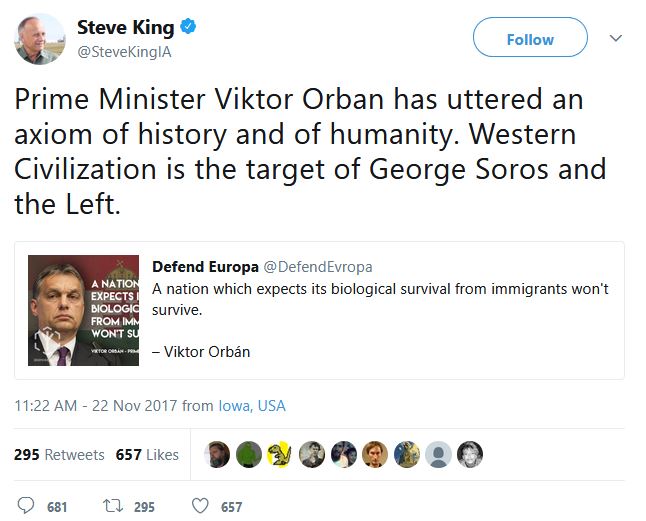
Now King has tweeted a claim that George Soros– a Jewish financier who has helped support democratic movements throughout Eastern Europe in the post-Soviet era and who is despised by, among others, the Putin regime in Russia— is targeting “Western Civilization.”

steve king tweet

King approvingly retweeted a quote from Hungary’s rightwing Prime Minister Viktor Orban about the danger to a nation’s “biological survival” from immigrants. Since almost every American is an immigrant or a descendant of immigrants, perhaps King can explain how the US has managed to survive, biologically and otherwise.

Orban, another enemy of Soros , has defended the idea of “illiberal democracy”– citing the autocratic regimes of Russia and Turkey as examples. If King admires Orban, he has no business heading a subcommittee tasked with upholding the foundation of our  democracy– the Constitution of the United States.

Even more disturbing, King’s retweet comes from a white nationalist, anti-Muslim and antisemitic group called “Defend Europa.” The group’s website is full of articles with titles such as “The Attack on Whites & The Nuclear Family” and “The Bolshevik Revolution’s Jewish Roots.”

It should surprise no one– least of all Goodlatte– that King would share an ideological kinship with an outfit like “Defend Europa.”

Congressman Goodlatte: the next move is up to you.

Before you vote on the GOP tax plan, Congressman…

With the House of Representatives scheduled to vote today on the Republican tax plan, I’ve sent the following message to Congressman Goodlatte:

Dear Congressman Goodlatte:

All indications are that you will join the overwhelming majority of your Republican colleagues today in voting for the Republican tax plan– a plan tilted heavily in favor of wealthy people and large corporations that will add up to $1.5 trillion to the national debt over the next decade.

Before you vote, however, I hope you will take a few minutes to watch the following videos.

In the first, your House colleague Suzan DelBene’s questions to Thomas Barthold, chief of staff to the Joint Committee on Taxation, revealed in specific detail how the plan favors corporate interests over those of teachers, firefighters, home buyers and relocating workers.

In the second, you can see a less-than-enthusiastic response from corporate CEOs to the idea of investing the windfall they would receive under the tax plan.

Appearing Tuesday at The Wall Street Journal’s CEO Council conference in Washington, chief Trump administration economic advisor Gary Cohn watched with dismay when attendees were asked whether the reform bill would cause them to spend more on growth. Only a few responded.

“Why aren’t the other hands up?” Cohn asked, according to multiple press accounts.

Why indeed? And based on this response, are you– an outspoken advocate of balanced budgets– absolutely sure these tax breaks will produce the unprecedented increase in revenues required to fill the gap created by the Republican plan?

Update: Goodlatte joined 226 other Republicans and no Democrats to approve the tax plan.

Goodlatte and his committee question Jeff Sessions

Starting at 10 a.m. Tuesday, the Goodlatte-chaired House Judiciary Committee is questioning Attorney General Jeff Sessions. You can watch live here.

Now that Goodlatte has announced he will not seek reelection in 2018, and thus  should be free of partisan constraints, and given Sessions’s less-than-forthcoming answers to previous queries about the Trump campaign’s contact with Russian officials, it will be interesting to see if he asks the attorney general any difficult questions about this.

Goodlatte won’t seek reelection

Perhaps the election trends I noted in my previous post did worry Congressman Goodlatte after all. For whatever reason, he announced today that he will not seek reelection in 2018.

There’s a lot to digest here. Goodlatte was due to step down as the powerful chair of the House Judiciary Committee at the end of his current term. And especially if the Democrats win a House majority in 2018 (which appears more likely than ever), he would have been relatively powerless.

Jenna Portnoy, who covers Virginia’s congressional delegation for The Washington Post, writes:

Had he chosen to seek reelection, Goodlatte could have had a tough fight for the GOP nomination.

Although he has a solid conservative voting record, Goodlatte’s quarter century of public service and status in the House leadership has made him a target of Republicans activists in his district.

Last year, his ally lost the leadership of the GOP committee in the congressional district to businessman Scott Sayre.

“[Goodlatte] has served us for a couple of decades now and there are many people who are happy with what he has done,” he said Thursday. “You can’t make everybody happy.”

Republicans expected to consider vying for the nomination for the seat, include state Del. Ben Cline, Goodlatte’s former chief of staff, and Cynthia Dunbar, a national committeewoman. In an interview Thursday, Sayre ruled out running himself.

Stay tuned.

Election trend should worry Goodlatte

Although Republican Ed Gillespie won about 60 percent of the vote in Virginia’s Sixth Congressional District while losing decisively to Ralph Northam in Tuesday’s race for governor, Congressman Goodlatte should take a hard look at a map that appears in The New York Times:

trend map

It shows in blue the precincts where Northam won a higher percentage of the vote than Hillary Clinton did in 2016. Goodlatte would no doubt notice that this happened in the overwhelming majority of precincts in the Sixth District. Electoral trends are important, and this one ought to cause a shiver of concern for even so complacent a politician as Goodlatte.

“Deficit hawk” Goodlatte backs budget-busting tax plan

Congressman Goodlatte rarely misses an opportunity to proclaim his opposition to deficit spending or his support for a Constitutional amendment requiring a balanced federal budget.

His record on these principles is another matter. So it comes as no surprise that Goodlatte has reacted favorably to the Republican tax plan which would add $1.5 trillion to the national debt over 10 years.

Republicans assure us that this tax plan– which overwhelmingly favors big corporations and the wealthiest Americans— would stimulate unprecedented economic growth and generate enough new tax revenue to fill the gap. But there is absolutely no evidence to support this claim– and plenty of evidence to the contrary. The massive 2001 tax cuts under President George W. Bush did little to boost the economy and instead contributed to the huge deficits during his administration.  A tax plan in Kansas similar to the current Republican plan was a failure that had to be scrapped.

Bruce Bartlett, an adviser to President Ronald Reagan, observed: “In reality, there’s no evidence that a tax cut now would spur growth.”

If Goodlatte nevertheless goes along with this plan, his hypocrisy will be exposed once again.

Goodlatte mum as Congress fails to act on children’s health insurance

While Congressman Goodlatte seems especially eager to inform his Sixth District constituents about his recent visit to a drug-smuggling tunnel and his inspection of border wall samples, he has been notably silent about an issue much closer to home– the imminent threat to the health insurance that covers 65,000 children and 1,100 pregnant women in Virginia.

The [Virginia] Department of Medical Assistance Services, or DMAS, has to be ready by the beginning of December so it can give families at least 60 days notice that their children will no longer be covered by the program when money runs out at the end of January.

“Congress is acting as if it’s just a matter of when the money runs out, and they’re not acknowledging the work and the investment that states have to make in trying to do this in the least chaotic way possible,” said Linda Nablo, DMAS’ chief deputy director.

Amidst wrangling over repeal of the Affordable Care Act, Congress didn’t meet a deadline to renew the program, often called CHIP, that has previously enjoyed bipartisan support.

Unless state lawmakers decide to pick up the multi-million-dollar tab, thousands in Virginia will lose coverage.

The result would look would like this: a child with asthma who loses health insurance will have nothing to prevent future asthmatic episodes and will almost certainly end up in the emergency room, said Dr. Richard Bennett, a pediatrician at the Bon Secours Richmond Community Hospital.

“The coverage that would have cost a few dollars to hundreds of dollars will now cost a family thousands to tens of thousands of dollars,” Bennett said.

With the health of nearly one-third of children in the Sixth District insured by CHIP and/or Medicaid, you’d think the impending crisis would be at the top of Goodlatte’s agenda. But perhaps his apparent lack of concern was foretold in 2009, when he voted in Congress against a law that extended CHIP coverage to four million children without health insurance.

Goodlatte finally finds something worth investigating

Since I started posting at Goodlatte Watch, I have noted the following:

— All Democrats on the House Judiciary Committee wrote to committee chair Bob Goodlatte in November asking him to schedule hearings on the potential conflicts between Donald Trump’s business interests and his future position as president of the United States.

— All Democrats on the House Judiciary Committee wrote to Goodlatte in May urging immediate hearings on President Trump’s firing of FBI director James Comey.

— All Democrats on the House Judiciary Committee wrote to Goodlatte in June sharply questioning his reluctance to hold hearings on the Trump administration’s possible obstruction of justice, the firing of Comey and the actions of Attorney General Jeff Sessions.

— After President Trump answered “100 percent” to a question about whether he was willing to testify under oath about his conversations with Comey before he was fired, Congressman Luis Gutierrez in June called on Goodlatte to invite Trump to do just that.

— All Democrats on the House Judiciary Committee wrote to Goodlatte in July to demand hearings after Trump in a New York Times interview attacked the credibility and fairness of Attorney General Jeff Sessions, Deputy Attorney General Rod Rosenstein, acting FBI Director Andrew McCabe, and Special Counsel Robert Mueller, and after news emerged of a 2016 meeting between Trump campaign officials and a Russian government attorney.

— All Democrats on the House Judiciary Committee wrote to Goodlatte in August asking for hearings on Trump’s pardon of former Arizona sheriff Joe Arpaio, who was convicted for ignoring a federal judge’s orders to stop detaining people based solely on the suspicion that they were in the country illegally.

— After a counter-protester was murdered by a white supremacist in Charlottesvile last August, even one of Goodlatte’s Republican colleagues on the Judiciary Committee wrote to him calling for a hearing on the dangers posed by white supremacist groups.

After ignoring all these requests– and not even having the courtesy to respond– Goodlatte has revealed what he considers far more important than any of the above: an investigation into the investigation of Hillary Clinton’s emails.

With this move, Goodlatte’s willingness– eagerness– to put party above country is on full and ugly display.

In his powerful speech announcing that he won’t seek reelection next year– a speech which ought to make Goodlatte and the vast majority of Congressional Republicans hang their heads in shame– Senator Jeff Flake of Arizona said: “Acting on conscience and principle is the manner in which we express our moral selves, and as such, loyalty to conscience and principle should supersede loyalty to any man or party.”

But Senator Flake is a Republican with integrity.


Goodlatte goes underground to prove himself wrong

Congressman Goodlatte and House Republican colleagues visited a drug-smuggling tunnel under the Mexican-US border to prove the utter futility of spending $25 billion to build a “big beautiful wall” to keep out drug smugglers.

Well, OK, that wasn’t really the purpose of the visit– Goodlatte, after all, is a strong advocate of the border wall boondoggle. But it might as well have been.

Meanwhile there’s no word from Goodlatte on some of those most responsible for the opioid addiction crisis in the US– the pharmaceutical industry, its lobbyists and their lackeys in Congress– who were called to account in a report on “60 Minutes” last Sunday by Joe Rannazzisi, who ran the Drug Enforcement Administration’s Office of Diversion Control, the division that regulates and investigates the pharmaceutical industry..

JOE RANNAZZISI: This is an industry that allowed millions and millions of drugs to go into bad pharmacies and doctors’ offices, that distributed them out to people who had no legitimate need for those drugs.

BILL WHITAKER: Who are these distributors?

JOE RANNAZZISI: The three largest distributors are Cardinal Health, McKesson, and AmerisourceBergen. They control probably 85 or 90 percent of the drugs going downstream.

Cardinal Health and McKesson were among the pharmaceutical industry donors to Goodlatte’s 2016 reelection campaign.