Goodlatte greeted by protesters in Edinburg

Congressman Goodlatte came to Edinburg in Shenandoah County on February 13. The Northern Virginia Daily reports:

[Goodlatte] invited area businesspeople, elected officials and other community leaders to a luncheon Monday to discuss, among other topics, President Donald Trump’s executive orders, the Affordable Care Act and Goodlatte’s role in what some perceived to be an attempt at weakening the Office of Congressional Ethics.

Edinburg’s Carmella’s Restaurant was the location selected for the talk, which was on an invitation-only basis. Goodlatte said that talks of this nature have been common throughout his time in Congress.

“This is really an opportunity for local elected officials, community leaders, leaders of nonprofit organizations (and) business leaders to talk about issues,” Goodlatte said. “This is something I’ve been doing the entire time that I’ve been in Congress and I do it all across my district. … We do these on a regular basis and it’s an opportunity for folks to hear what’s going on in Washington, but also, importantly to me, to tell me the things about issues that are going on here that may be of importance to them.”

Goodlatte said he supported President Trump’s now-suspended travel ban from seven Muslim-majority countries but he criticized its implementation. He again defended his failed effort to weaken the Office of Congressional Ethics and affirmed his support for repealing the Affordable Care Act and replacing it with a “better plan,” although he apparently offered no details.

Goodlatte and his guests were not the only people present, as 25 protesters outside the restaurant expressed their concerns about the way they feel Goodlatte has been representing them. Chief among them was what they feel is inadequate accessibility to their elected official. Among the signs present, one read “Town Hall Now” and another, “Bob, we need to talk.”

One protester was Kay Ely-Pierce, with Shenandoah Indivisibles.

“He has not had a town hall meeting where he allows his constituents to actually dialogue with him since 2013,” she said. “It needs to be a meeting where all his constituents can be. That’s what a town hall is and that’s what we’re here for. We just want to talk to him. … That face-to-face dialogue is really the key to human understanding.”

…..

The protesters stood just outside the restaurant as the congressman delivered his remarks inside.  Goodlatte explained why the event was closed to the public and offered ways for those seeking to communicate with him on how to do so.

“We have a large list and we invite people from that list and we encourage people to sign up for the list, but that’s how that works,” he said. “I am very, very accessible to them (protesters). I stopped and said hello to them on my way in here, but we have a multitude of different ways to communicate with our constituents, including telephone town hall meetings, including open-door meetings where they can speak to my staff – and everything that my staff receives from any constituent comes to me – and we always respond to them, too. We’re interested in hearing their concerns as well.”

…..

When asked about the demonstrators’ desire for an in-person town hall meeting, Goodlatte said that he and his office are “considering what all of our options are,” and again referred to the telephone town halls, which Ely-Pierce likened to a child being raised by its parents via Skype.

Goodlatte described the protest as part of a larger, wider-reaching demonstration.

“This is a nationwide thing,” he said. “This is not something that’s unique to the 6th District. This is going on in every single congressional district in the country. It’s organized by a national organization that is not happy with the outcome of the election. These are my constituents so they’re welcome to be here and express their opinions as well.”

Goodlatte should know that the protest in Edinburg, and other protests across the Sixth District, are not organized by a “national organization.” They are organized and attended by the constituents he is supposed to be representing in Congress. It’s good that he believes these constituents are welcome to express their opinions. It would be even better if he would take the time to meet with them face-to-face and listen to them.
Your move, Congressman Goodlatte

In my first post at Goodlatte Watch in December, I reported:

Sixteen Democrats on the House Judiciary Committee have written to chairman Bob Goodlatte asking him to schedule hearings on the potential conflicts between Donald Trump’s business interests and his future position as president of the United States.

I can find no evidence that Goodlatte even bothered to reply to the letter, let alone schedule hearings.

Now The Washington Post reports:

In an escalation of Democratic efforts to highlight questions about President Trump’s potential conflicts of interest and alleged ties to Russia, a senior House Democrat is dusting off a little-used legislative tool to force a committee debate or floor vote on the issue.

Rep. Jerrold Nadler (D-N.Y.) filed a “resolution of inquiry” Thursday, a relatively obscure parliamentary tactic used to force presidents and executive-branch agencies to share records with Congress. Under House practice, such a resolution must be debated and acted upon in committee or else it can be discharged to the House floor for consideration.

…..

Nadler, the No. 2-ranking Democrat on the Judiciary Committee, said that his move came after Democrats sent two letters to Judiciary Committee Chairman Bob Goodlatte (R-Va.) and another letter to House Speaker Paul D. Ryan (R-Wis.) asking for investigations into Trump’s financial entanglements.

“All of this demands investigation, and of course they’ve refused,” Nadler said Thursday at the House Democrats’ annual policy retreat [in Baltimore]. “This resolution will force them to confront the issue.”

…..

Under House rules, a resolution of inquiry is referred to a committee, which has 14 legislative days to debate and vote on whether how it should be reported to the floor. If the committee does not take action in that 14-day span, the measure can be called up on the House floor for a debate and vote.

A spokeswoman for Goodlatte declined to comment Thursday on whether he plans to take up Nadler’s resolution.

Of course she did.

Unfortunately for Goodlatte’s efforts to evade his responsibilities as head of the Judiciary Committee, things just got real.

Update: You can read the letters that the House Judiciary Committee Democrats sent to Goodlatte here and here.

Goodlatte’s campaign well-funded by tech, internet, entertainment industries

Congressman Goodlatte staunchly defended President Trump’s  now-suspended executive order banning entry to the United States from seven Muslim-majority countries and otherwise restricting travel and immigration. As chair of the House Judiciary Committee, he says he “proudly allowed” his staff to work with Trump’s staff on preparing the order– although he won’t say if his staffers signed nondisclosure agreements before doing so.

In contrast, more than 100 companies filed court papers February 5 declaring that Trump’s executive order “violates the immigration laws and the Constitution.”

The ban represents “a sudden shift in the rules governing entry into the United States, and is inflicting substantial harm on U.S. companies,” says the court document.

Among the companies signing on to the motion are Facebook, Google, Intel, Microsoft, Twitter and eBay– all of which contributed to Goodlatte’s most recent reelection campaign through their political action committees.

According to filings with the Federal Election Commission, Goodlatte’s campaign committee received more than $1 million from non-party PACs in 2015 and 2016. They included:

• $10,000 from Facebook Inc. PAC

• $10,000 from Google NetPac

• $10,000 from Intel PAC

• $10,000 from Microsoft Corporation PAC

• $1,000 from Twitter Inc. #PAC

• $7,500 from eBay Inc. Committee for Responsible Government

In an earlier court motion, Amazon supported the attorney general of Washington state in a lawsuit against Trump’s immigration order.

Amazon says it has 49 employees born in the seven Muslim-majority countries included in the ban who are legally working for the company in the United States or elsewhere. Amazon says their work and travel could be disrupted.

And yet– Amazon PAC donated $2,500 to Goodlatte’s campaign.

Goodlatte’s campaign had more predictable donors– including the American Petroleum Institute ($1,000), Bank of America ($2,500), Comcast ($10,000), Delta Airlines ($2,000), Dominion Power ($5,000), Eli Lilly ($4,000), Northrop Grumman ($5,000), Exxon Mobil ($10,000), Halliburton ($2,500), the NRA ($7,000) and Goldman Sachs ($3,500).

But among the committees helping to keep Goodlatte in Congress was the PAC for the Directors Guild of America ($10,000). At the DGA Awards February 4, The New York Times reports:

[P]resenters and winners repeatedly voiced alarm about the Trump administration, and said it was largely up to Hollywood to save the day.

“We all know the story being written now is really, really bad,” Alejandro G. Iñárritu, a previous two-time winner, for “Birdman” for “The Revenant” told the audience. “Actually it’s a bad remake of one of the worst stories of the last century. The only way we win is by telling good, complex, and truthful human stories.”

Goodlatte co-chairs the Congressional Internet Caucus. The House Judiciary Committee, which he chairs, includes a subcommittee on intellectual property and the internet.

The Staunton News Leader reported in 2015:

The congressman’s staunch support for copyright protections has endeared him to the liberal movie and music industry crowd. As he was about to assume his chairmanship two years ago, CNET Magazine announced Goodlatte as “Hollywood’s new copyright ally.” The International Business Times reported… that the Motion Picture Association of America has a priority of raising money for Goodlatte.

He said he doesn’t consider himself “Hollywood’s congressmen.” His alliance with movie and music makers stems from his focus on intellectual property, the ideas and inventions that he believes drive economic growth.

“You come up with a brilliant idea, whether it’s creative like art or music, or movies or books or an invention —something that can be patented,” Goodlatte said. “Then you get rewarded by the government protecting your rights under that; you then have the opportunity to grow the economy.”

Other Hollywood donors to Goodlatte were the PACs of 21st Century Fox ($7,500), Sony Pictures Entertainment ($10,000), Walt Disney Company ($5,500) and the Motion Picture Association of America ($3,000). The Recording Industry Association of America kicked in $5,000.

Ultimately it’s up to ordinary Americans, not Hollywood, to “save the day.” But if Hollywood wants to help, it could start by cutting off the money it doles out to Trump-supporting politicians like Bob Goodlatte.

Goodlatte backs national “right to work” law

Congressman Goodlatte has signed on as a co-sponsor of Rep. Steve King’s bill to further cripple organized labor in the US by enacting a national “right to work” law.

 The first thing to know about misnamed “right to work” laws is that they do not guarantee anyone the right to work. Instead they forbid employers and workers from negotiating agreements that require all workers who benefit from a union contract– including wage increases, health and retirement benefits, paid vacations and a grievance procedure– to pay a share of the cost of union representation. It’s a matter of simple fairness.

“Right to work” should be more accurately called “right to freeload.”

But “right to work” laws don’t just hurt union members. They reduce wages for non-union workers too. In “right to work” states the median annual household income for all families is $6,500 less  than in non-“right to work” states.

So in one sense these laws do guarantee the right to work– for less.

Currently individual states are permitted to enact “right to work” laws. But under the King-Goodlatte bill, they would have no choice in the matter.

Unfortunately Virginia is saddled with a “right to work” law. But that wasn’t enough for Republicans in the General Assembly, who last November tried to get voters to enshrine “right to work” in the state constitution. Fortunately they failed, but there ought to be  lessons for Goodlatte in that failure.

While Goodlatte was being reelected to represent Virginia’s Sixth District by a two-to-one margin, majorities of voters in some of the most heavily Republican parts of the district were rejecting “right to work.” These include the counties of Augusta, Bath, Highland, Page and Rockbridge.

Perhaps the people of the Sixth District aren’t as hostile to organized labor as Goodlatte thinks they should be. 

Goodlatte spotted in Amherst

Although the public was not invited, WDBJ7 reports that Congressman Goodlatte hosted a luncheon with “civic leaders” in Amherst on Feburary 6, at which he discussed repealing and replacing the Affordable Care Act.

Goodlatte said Congress is hoping to enact a replacement that will result in lower insurance premiums.

He added there will be a transition period for people on the current health exchange to find new insurance.

Perhaps someone more familiar with Amherst can say how representative these “civic leaders” are. But in the video of the luncheon I spotted no African-Americans, even though African-Americans are 30 percent of the town’s population.

And Goodlatte’s assurances that there will be a replacement for the ACA that will provide insurance to everyone at a lower cost are starting to wear thin. All indications are that Congressional Republicans are still flailing in their efforts to find a suitable replacement.

The search is on

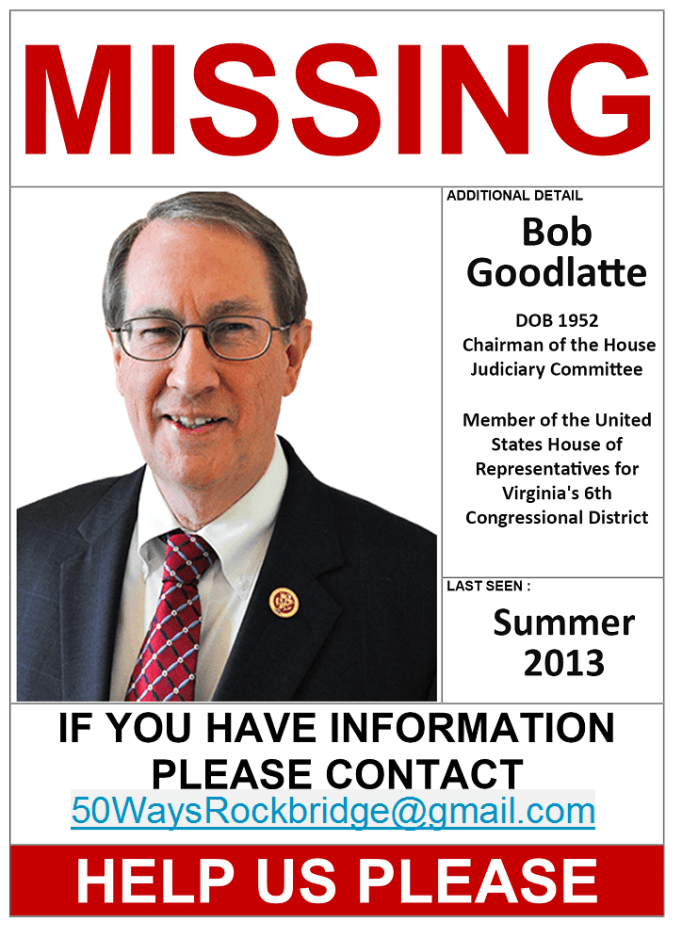
Congressman Goodlatte has not held an open town hall meeting in the Sixth District since August 2013 and has consistently stonewalled requests from constituents to meet with them face to face. This is one result.

missing-poster

Is Goodlatte good with Trump’s attack on the judiciary?

When President Trump called US District Court Judge James L. Robart— who was appointed to the bench by George W. Bush and unanimously confirmed by the Senate– a “so-called judge” for ruling against his immigration order, the silence from most Republicans in Congress was deafening.

When Trump said Judge Robart would be to blame “if something happens,” the lack of Republican outrage at Trump’s attack on an independent judiciary echoed even louder.

Politico reports:

Not a single member of House GOP leadership, nor House Judiciary Committee Chairman Bob Goodlatte (R-Va.), came to Robart’s defense or rebuked Trump. Many senior House Republicans privately feel Trump’s comments are counterproductive, but they aren’t willing to criticize Trump publicly because they feel it distracts from their legislative messaging.

Of all members of Congress, the chair of the Judiciary Committee should be among the most willing to oppose an effort by the President of the United States to demean and intimidate a federal judge. This is nothing less than a frontal assault on the constitutional separation of powers, and Goodlatte should know it. If he does know it, but still won’t say anything, it tells us all we need to know about him.

Goodlatte votes to kill worker protection and stream protection rules

Congressman Goodlatte was among the 233 Republicans and three Democrats (to 186 Democrats and one Republican) in the House of Representatives to vote against a rule that would forbid federal contractors with a history of workplace violations from receiving new contracts.

The Fair Pay and Safe Workplaces rule, signed by President Obama in August, would require would-be contractors to disclose violations of laws on workplace safety, workplace discrimination, labor organizing rights, or minimum wage and overtime.

The GOP-controlled Senate is expected to pass the measure as well, since Democrats can’t filibuster a resolution of disapproval. If that happens, the Labor Department will be forbidden from moving forward with Obama’s executive order…

Republicans used the same method this week to kill what’s known as the stream protection rule. That rule restricted coal companies from dumping mine refuse into waterways and required them to restore streams they’d damaged.

Goodlatte voted to overturn that rule too.

House Democrats keep pressure on Goodlatte over staffers’ help for Trump

Politico reports:

House Judiciary Committee Democrats on Thursday pressed Chairman Bob Goodlatte for more information about his staff’s secret role helping craft President Donald Trump’s executive order restricting refugees and immigration.

The panel’s ranking member, Rep. John Conyers (D-Mich.), in a letter to Goodlatte, asked whether the Virginia Republican approved his staff signing nondisclosure agreements with Trump officials and allowed the aides to work on the travel ban on committee time, and whether Goodlatte reviewed any of their work on the executive order.

…..

Conyers’ letter came just a couple hours after nine House Democrats pressed Speaker Paul Ryan in a separate letter Thursday to say whether the unusual situation broke chamber rules.

Goodlatte apparently never responded to a letter from Conyers and other Judiciary Committee Democrats in November asking him to schedule hearings on the potential conflicts between then President-elect Trump’s business interests and his position as President of the United States. So there’s no reason to expect the congressman will reply to Conyers’s latest letter either.

Watchdog group files complaint against Goodlatte’s committee staffers

The Campaign for Accountability has called on the Office of Congressional Ethics to investigate whether staffers on the Goodlatte-chaired House Judiciary Committee broke any federal laws or House rules by helping President-elect Trump draft his executive order on immigration. 

According to a CfA press release:

CfA Acting Executive Director Daniel E. Stevens stated, “Employees of the United States House of Representatives are duty-bound to serve Members of Congress and the Americans who elected them.  It appears that these House staffers surreptitiously worked on issues for the President-elect, and perhaps later the White House, without even telling the members for whom they worked.  The OCE should open an investigation immediately and determine whether these staffers broke any federal laws or House rules.”

On January 30, 2017, Politico reported that several House Judiciary Committee professional staff members had helped the Trump transition team draft an executive order limiting immigration from seven Muslim-majority countries.  The paper also reported that the staffers signed nondisclosure agreements with the transition team, and that they did not inform the Judiciary Committee Chairman Bob Goodlatte (R-VA) or House Leadership about their work on the controversial measure.

Federal law and House rules require House staffers to work on House business and to “give a full day’s labor for a full day’s pay.”  Moreover, House rules specifically state that lawyers are prohibited from consulting and advising clients beyond the House of Representatives to avoid conflicts of interest.  Given that many staffers of the House Judiciary Committee are lawyers, the staffers that worked on this order may have run afoul of several laws and House rules.

You can read the CfA’s complaint here.

Congressman Goodlatte has said he “proudly allowed” his committee staff to assist Trump. However he has dodged questions about whether the staffers signed non-disclosure agreements with Trump, as has been reported.